Generating tests from GitHub and Stripe payloads
GitHub and Stripe publish a schema for every webhook they send. workflow-tester uses those schemas to build the payloads your workflow is likely to meet: a field set to null, an optional object left out, an empty string.
1. Add a contract
A contract says which events a workflow's trigger receives.
workflow-tester contracts add workflows/issue-triage.json --vendor github --events issues-opened
Expected output:
workflows/issue-triage.contract.yaml
  vendor  github @ 1.1.4
  events  issues-opened
  shape   ../.workflow-tester/contracts/github.issues-opened.schema.json
This creates:
workflows/
└── issue-triage.contract.yaml
.workflow-tester/
└── contracts/
    ├── github.issues-opened.examples.json
    └── github.issues-opened.schema.json
The sample workflow is docs/demo/issue-triage.json.
Event names
| Vendor | Names look like | Example |
|---|---|---|
| GitHub | The event plus its action | issues-opened, pull-request-opened |
| Stripe | Stripe's own names | invoice.paid, charge.refunded |
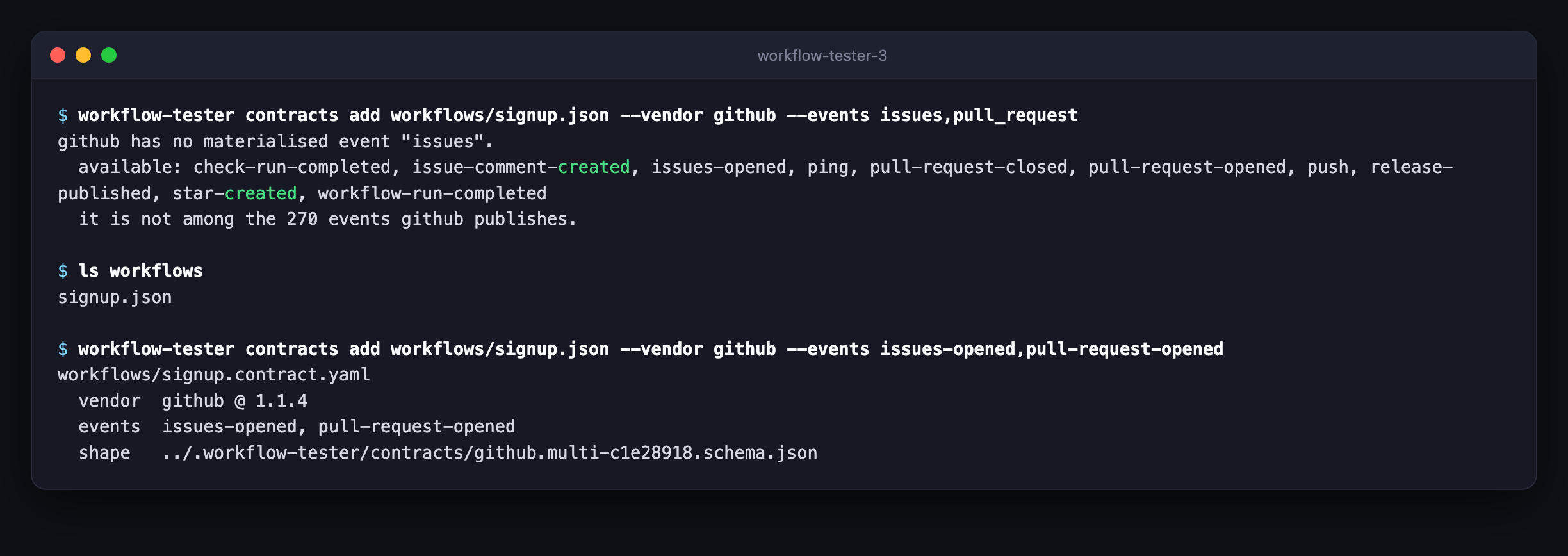
List a vendor's event names with workflow-tester vendors events github. A wrong name is rejected before anything is written, and the error lists the names that exist.
The contract file
version: 1
trigger: Webhook
source:
  kind: vendor
  vendor: github
  events:
    - issues-opened
shape:
  schema: ../.workflow-tester/contracts/github.issues-opened.schema.json
  examples: ../.workflow-tester/contracts/github.issues-opened.examples.json

# overrides:
#   required: []
#   never: []
#   only: []
overrides is the only part you edit by hand.
| Override | Takes | Effect |
|---|---|---|
required | Paths | Never leave these fields out, even when the schema says they are optional |
never | Paths | Leave these fields, and everything under them, unchanged |
only | Event names | Generate cases for these events only |
Paths are dotted, with [] for every element of an array and [n] for one.
2. Generate the cases
workflow-tester gen
Expected output:
workflows/issue-triage.json → github.issues-opened: 14 case(s) — 14 added, 0 retired, 0 unchanged (budget 14 for 4 nodes, 486 discarded)
Cases are written to .workflow-tester/cases/. Commit them.
- The same contract and workflow always produce identical files.
gen --checkwrites nothing and exits 1 when the cases are out of date. Use it in pre-commit and CI.--max Nchanges how many cases are kept.
What gets generated
Each case is a real vendor example with one or two things changed.
| Kind | Change |
|---|---|
optional-absent | An optional field is left out |
nullable-null | A nullable field is null |
oneOf-branch | Another branch of a oneOf |
enum-value | Another allowed value |
array-cardinality | An empty array, or one with several items |
format-edge | An empty string, unicode, 0, -1, a very large number |
Only fields your workflow reads are varied.
3. Run them
workflow-tester run --only generated
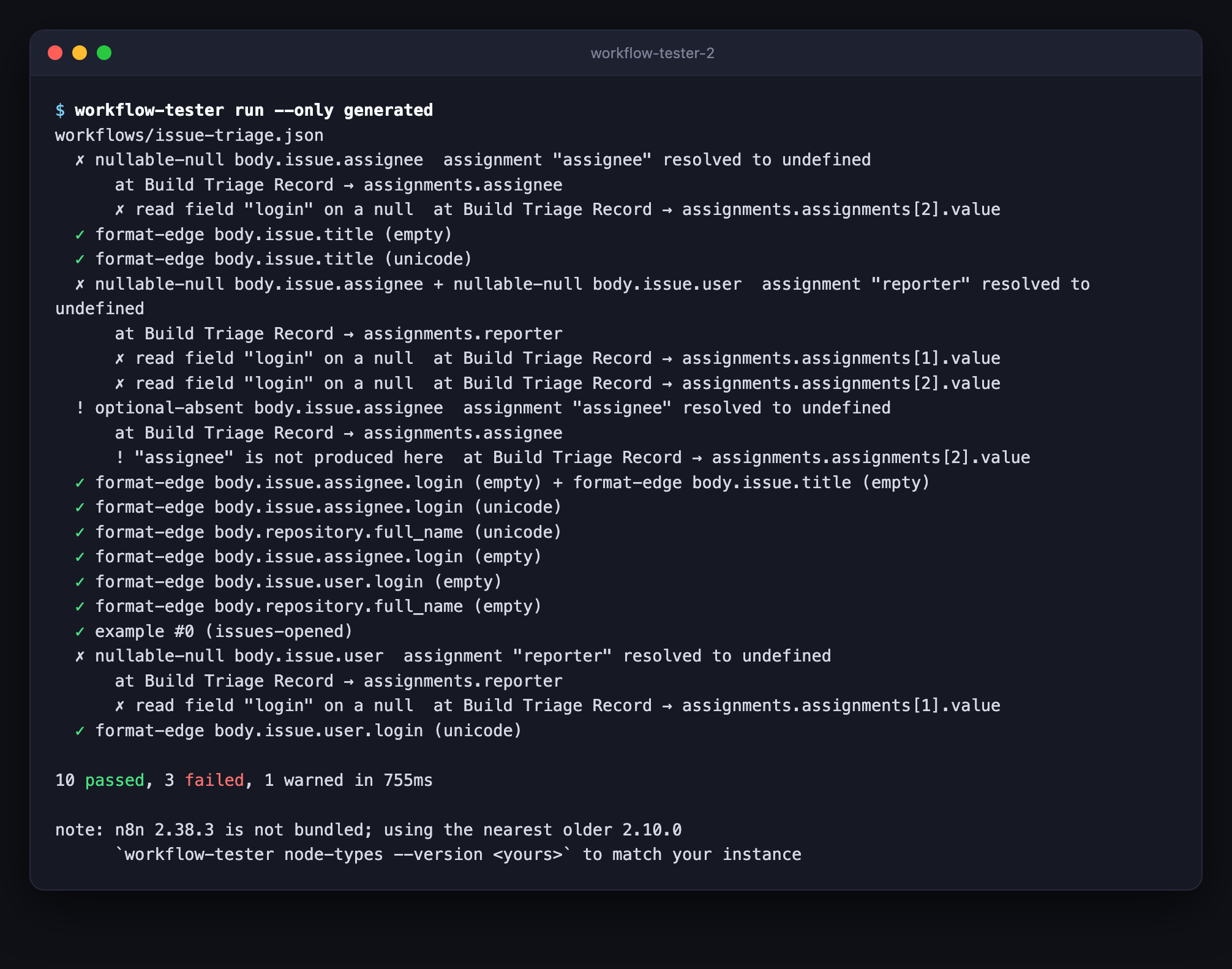
On the sample workflow this ends with 10 passed, 3 failed, 1 warned. The workflow reads issue.assignee.login, and GitHub sends assignee: null when nobody is assigned. It also finds that issue.user can be null.
Keep a failing case
workflow-tester explain 11df5e3da2dee888
workflow-tester promote 11df5e3da2dee888 --name missing-assignee
| Command | What it does |
|---|---|
explain <caseId> | Prints the case as a complete test file, payload included, with the result of its last run |
promote <caseId> | Copies the case into .workflow-tester/tests/ with a then: block to fill in, and stops gen from retiring it |
Supported vendors
workflow-tester vendors list
Expected output:
vendor    coverage       spec version          events
github    schema         1.1.4                 10 of 270
stripe    schema         2026-08-26.dahlia     7 of 265
slack     nothing        —                     —
Slack publishes no schema for its event payloads. For Slack, or for a webhook of your own, write tests by hand.